

Your next revenue opportunity may already be sitting inside your existing customers, hidden in the workloads you can’t see.
Customer environments change constantly as new VMs go live and departments add SaaS tools. Your backup job list rarely keeps pace with those changes. That leaves some workloads that need protection you’re not providing, and others you’re already protecting without billing for them.
Those gaps between what you protect and what actually exists are your blind spots, and they represent revenue you haven’t captured yet.
Three Ways a Blind Spot Shows Up In Customer Environments
Not every blind spot costs you the same way, and knowing which kind you’re dealing with shapes the conversation you have with the customer.
- The unprotected workload. Nobody is backing it up, and the customer will likely look to you when it fails. It’s a risk today, but it’s also a service they need and aren’t buying yet.
- The unbilled workload. You’re already protecting it, but it never made it into the contract. Maybe it got added to a policy during a busy week, or the customer’s environment grew faster than their pricing did. Either way, you’re delivering value you aren’t getting paid for.
- The expansion signal. Some discoveries point to something bigger, like a new cloud platform, a new line of business, or a new team. These aren’t just line items. They show where the customer is heading and give you a reason to grow the relationship.
Each of these leads to a different conversation: selling a new service, correcting a contract, or planning for growth. All three depend on the same thing, though. You must find the workload before you can do anything with it, and that means looking in two places most MSPs only half check.
Protecting Revenue vs. Finding It
Blind spots fall into two categories, and each one requires a different kind of review
- What you know about but can’t confidently say is protected. These workloads are on your radar, but failed jobs, outdated policies, and partial coverage can leave them exposed without anyone noticing. Closing these gaps protects the revenue you already have, since nothing erodes customer confidence faster than a restore that fails.
- What you don’t know exists at all. These workloads never made it onto your radar, which makes them harder to find but also where the new revenue lives. Discovering them surfaces unprotected workloads, unbilled ones, and expansion signals all at once.
The first category is about delivering the data protection services you promised. The second is about finding out what you should be promising. Both point to the same exercise: an asset audit, done with a different goal than most MSPs bring to it.
Audit for Revenue, Not Just Risk
The fastest way to find blind spots is an asset audit, but not the kind that stops at checking whether systems are patched and backed up. A revenue-focused audit asks a bigger question: do the services you deliver match the services you sell? Answering it means comparing three lists that rarely get looked at side by side:
- What’s running in the customer’s environment
- What’s protected by your backup services
- What’s billed in the customer’s contract
Wherever those lists don’t line up, you’ve found something worth acting on. A workload that’s running but not protected is exposure. One that’s protected but not billed is margin you’re giving away. A cluster of new workloads that fits none of your current services is a signal the customer needs more from you.
What you do with those findings matters as much as finding them.
Lead with the Finding, Not the Invoice
Not every discovered workload should become a new invoice line item. If the first thing a customer hears after an audit is a higher bill, you’ve turned a trust-building moment into a sales pitch. The stronger approach is to bring findings to the customer as exactly that: findings.
- For unprotected workloads, explain the risk and recommend how to close it. The service conversation follows naturally.
- For unbilled workloads, align the contract with what you are delivering. Framed as housekeeping, it’s a correction, not a price increase.
- For expansion signals, ask about the customer’s plans before proposing anything. Understanding where they’re heading gives you a better pitch later.
This approach positions you as the partner who knows their environment better than anyone else, and that reputation is worth more than any single upsell. It also makes the audit easy to repeat, which matters because new blind spots will emerge.
Make Unprotected Asset Audits a Habit, Not a Project
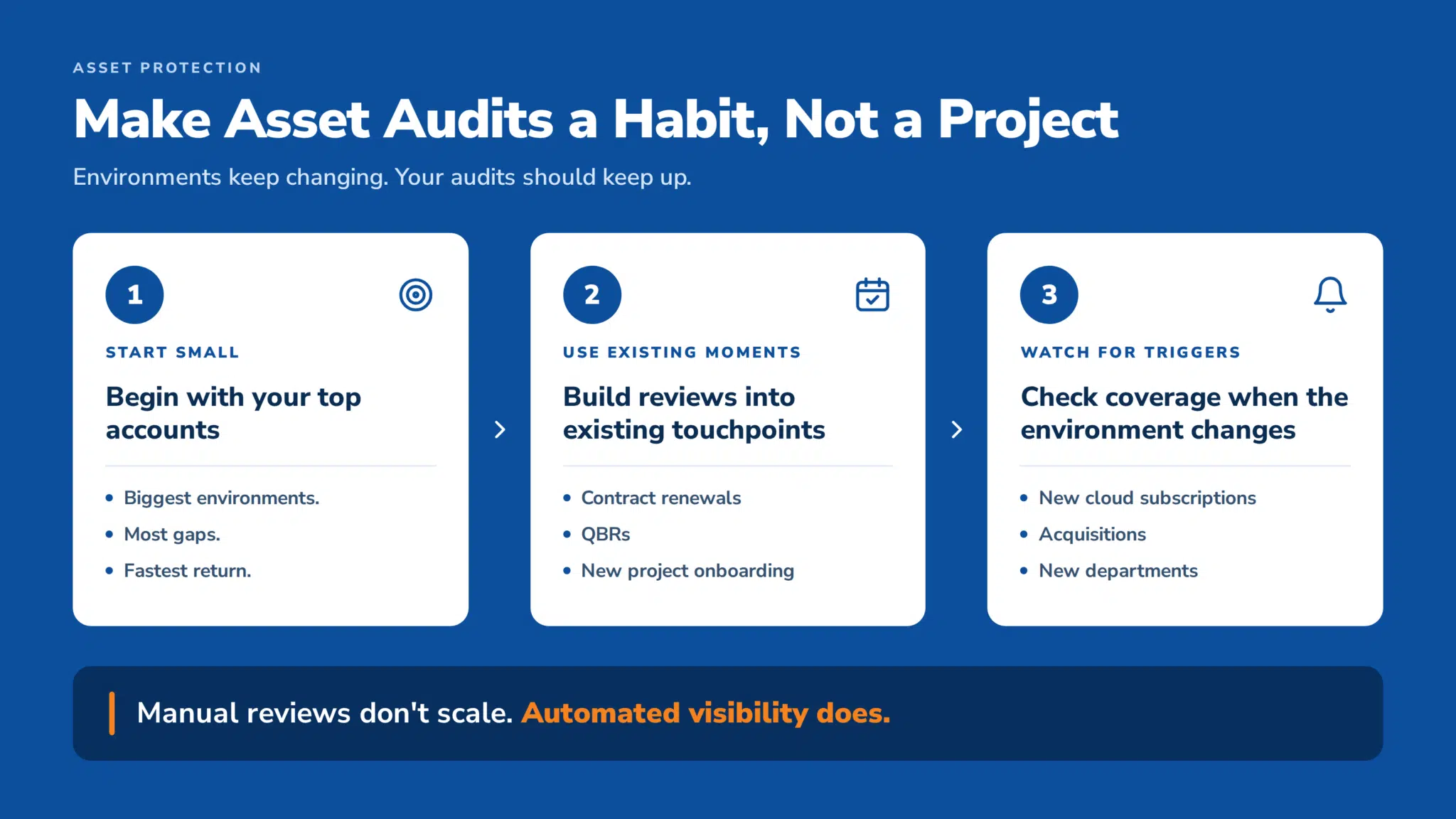
Customer environments keep changing after the audit ends, which means a one-time cleanup only buys you a few months of accuracy. The MSPs that capture this revenue consistently build discovery into how they run accounts.
Start with your top accounts. Your largest customers usually have the most complex environments and the most room for gaps, so they’ll show you the biggest return fastest.
Tie reviews to moments that already exist. Contract renewals, QBRs, and onboarding for new projects are natural points to compare what’s running, protected, and billed.
Watch for triggers between reviews. A new cloud subscription, an acquisition, or a new department coming online are all signs the environment just outgrew its coverage.
The catch is that manual reviews get harder as your customer base grows and each customer’s environment spans more platforms. At some point, finding blind spots stops being a checklist problem and becomes a visibility problem.
Unprotected Asset Visibility Is the Real Opportunity
Multi-platform environments aren’t going away. Customers will keep adding cloud workloads, SaaS tools, and new backup platforms, and every addition creates another place for unprotected assets to hide.
Most MSPs can see the workloads they already back up, but far fewer can see what’s running outside that coverage. Closing that gap manually means pulling inventories, cross-checking them against backup jobs, and repeating the process every time an environment changes.
That doesn’t scale.
The MSPs that capture this revenue consistently automate it, comparing asset inventories against backup coverage across every customer and flagging unprotected assets as soon as they appear. That shifts discovery from a periodic project to a continuous process, so gaps surface before they turn into incidents and billable work surfaces before it turns into someone else’s service.
That’s the shift worth making. Visibility doesn’t just help you protect what you manage. It shows you what’s unprotected, what’s unbilled, and what’s next, and in most customer bases, that adds up to more than what you’re getting paid for.