Backup and data protection oversight built for banking and finance
Backup environments in financial institutions span business lines, geographies, and a stack of regulators, all expecting the same thing: proof it works, on demand. Bocada automates that proof so your team spends less time assembling evidence and more time on the operational resilience it’s supposed to support.
Backup, storage, and virtualization health across every business line and geography, tied together the way examiners and compliance teams expect.
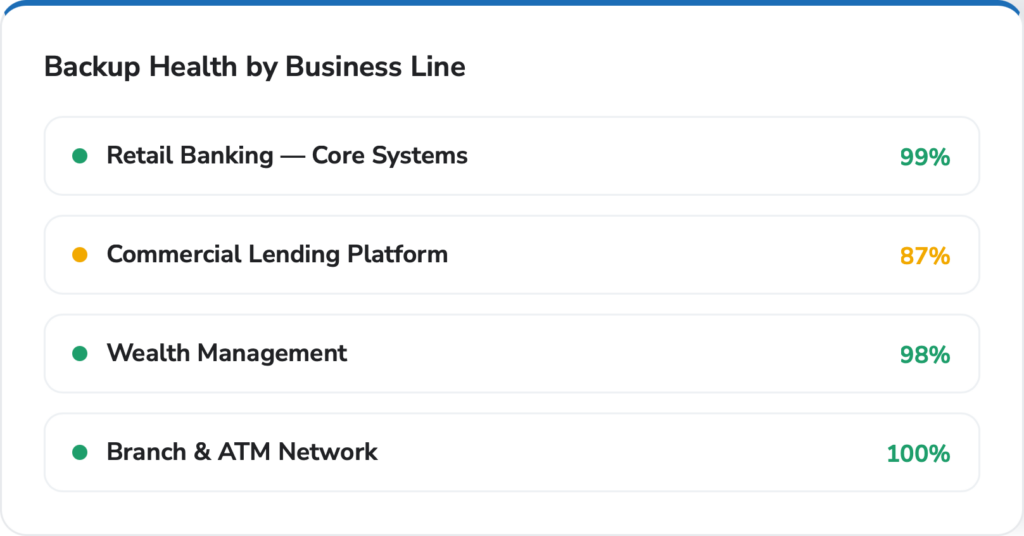
Consolidate backup monitoring across every business line, branch, and geography into one dashboard, the enterprise-wide view FFIEC’s business continuity testing standard explicitly calls for
Connect that same dashboard to your virtualizers, storage systems, and ticketing platform, so backup monitoring sits inside one comprehensive view of your data protection operations, not off to the side of it
Normalize data across your entire backup and storage stack, cloud, on-prem, tape, so backup recency and location are always known, not reconstructed after the fact
See at a glance which system, business unit, or region is at risk, instead of learning it from a business line manager after the fact
In practice: a compliance lead sees every business line and geography’s backup status side by side, exactly the enterprise-wide view an examiner expects to see.
Prove compliance, pass every audit, on demand
FFIEC, SOX, and GLBA compliance isn’t a one-time check. It’s an audit trail you have to prove, indefinitely.
Maintain the audit trail for as long as your retention policy and regulators require, not just the last few weeks, meeting FFIEC’s expectation for durable compliance evidence
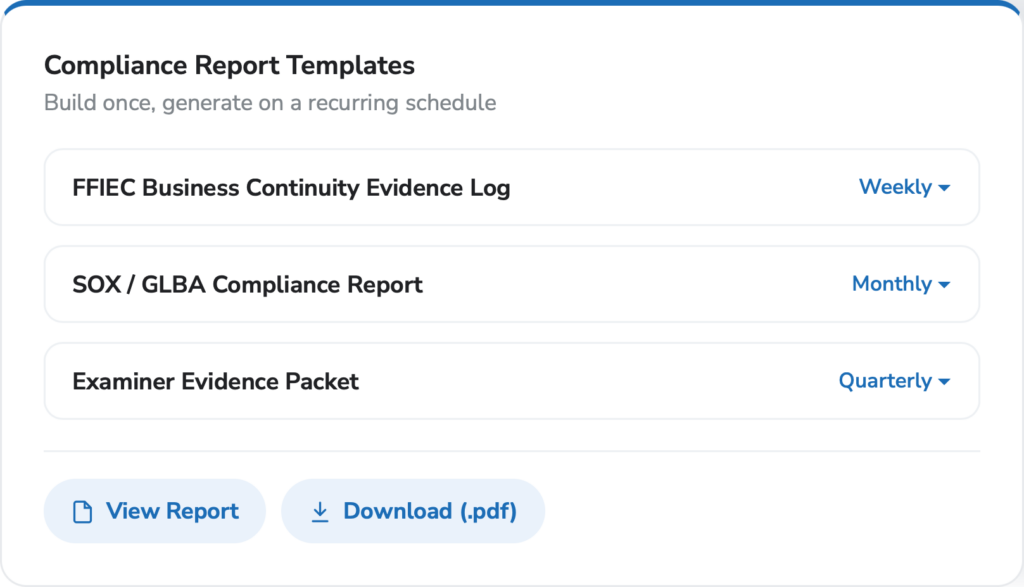
Generate the compliance and SLA reports examiners and auditors actually ask for, automatically, on a recurring schedule, instead of assembling audit evidence the week before an exam
Give auditors direct access to Bocada’s AI agent, so an information request gets answered on the spot instead of costing your team a week
In practice: an examiner’s information request gets answered on the spot by Bocada’s AI agent, not a week later.
Find unprotected resources that aren’t visible to you
New accounts, branches, and vendors expand the environment faster than backup policy, or compliance oversight, can track.
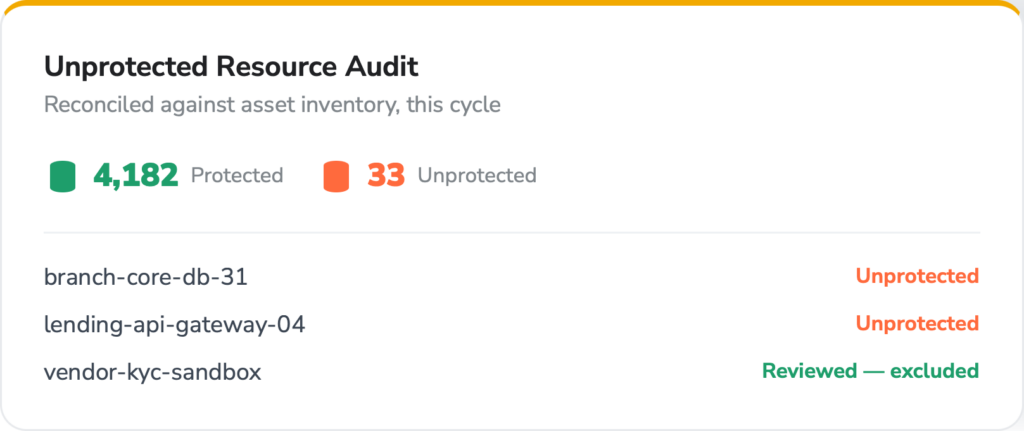
Cross-reference your asset inventory against actual backup activity to catch systems that were stood up and never added to a backup policy
Extend the same discipline to third-party and vendor-managed systems your institution is still accountable for, even when a vendor manages the infrastructure
Get a documented, audit-ready record of every resource you’ve reviewed and consciously decided not to protect, and why
In practice: a new branch system stood up last quarter shows up in the audit, instead of surfacing for the first time during an exam.
Automate response to strengthen cyber resilience
Less time spent on manual triage is what makes a fast, resilient response to a real threat possible.
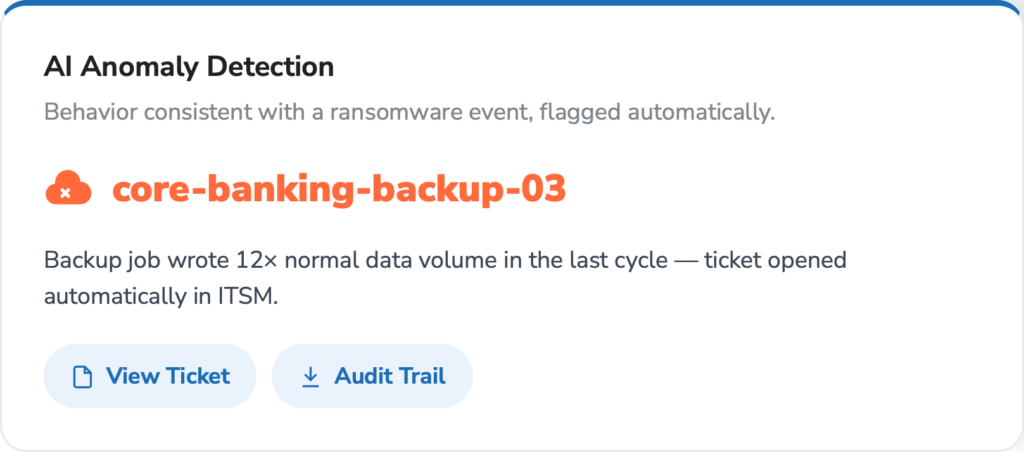
Bocada’s AI-powered anomaly detection flags the kind of backup behavior that signals ransomware already at work, without a person watching every job
Let Bocada’s AI agent diagnose what actually went wrong and open, update, and close the ticket automatically as it’s resolved, so response speed doesn’t depend on someone noticing first
Recover within the tight windows Tier-1 financial systems demand, since a multi-day reconstruction of lost data is rarely something a regulator, or a customer, will accept
In practice: a ransomware-pattern anomaly on the core banking backup opens a ticket the moment it’s detected, not after a customer-facing outage is reported.
Prevent storage from causing compliance issues
Running out of capacity doesn’t just cost money. It’s how a compliance gap gets created.
Get alerted automatically as a system approaches capacity, so a backup job doesn’t fail simply because there was nowhere left to write
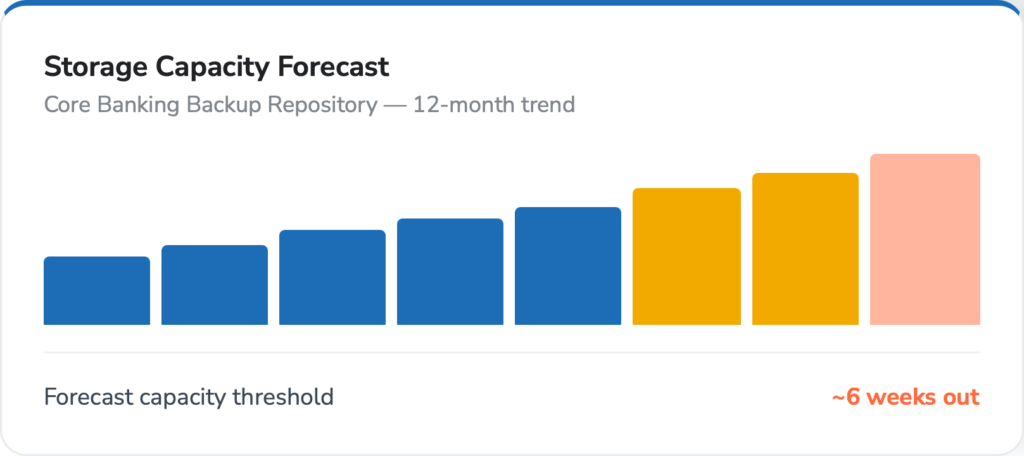
Forecast storage needs using AI trained on your institution’s actual growth patterns, not a generic curve, satisfying FFIEC’s expectation that capacity planning be based on real data
Track cost and consumption trends across cloud and on-prem storage in one place, so a growing footprint doesn’t become a budget surprise, or the reason a backup, and a compliance obligation, gets missed
In practice: a business line nearing storage capacity gets flagged and expanded weeks before it could have blocked a backup, and created a compliance gap.